
概览 Brain-DiT 通过元数据条件扩散学习多状态 fMRI 表征。在 7 项下游任务中,论文观察到其相对重建和对齐目标的优势,同时发现不同预测任务偏好不同尺度的特征。
一种表征能否覆盖静息、任务和睡眠?
静息扫描、任务实验和睡眠记录反映脑活动的不同侧面。只在少数状态上训练,可能限制基座模型迁移到新场景的能力。
Brain-DiT 研究两个相互关联的问题:预训练应该优化什么目标?模型又该如何处理人群与记录情境的差异?它以生成式去噪为学习任务,并把元数据作为条件信息。
把去噪过程变成表征学习
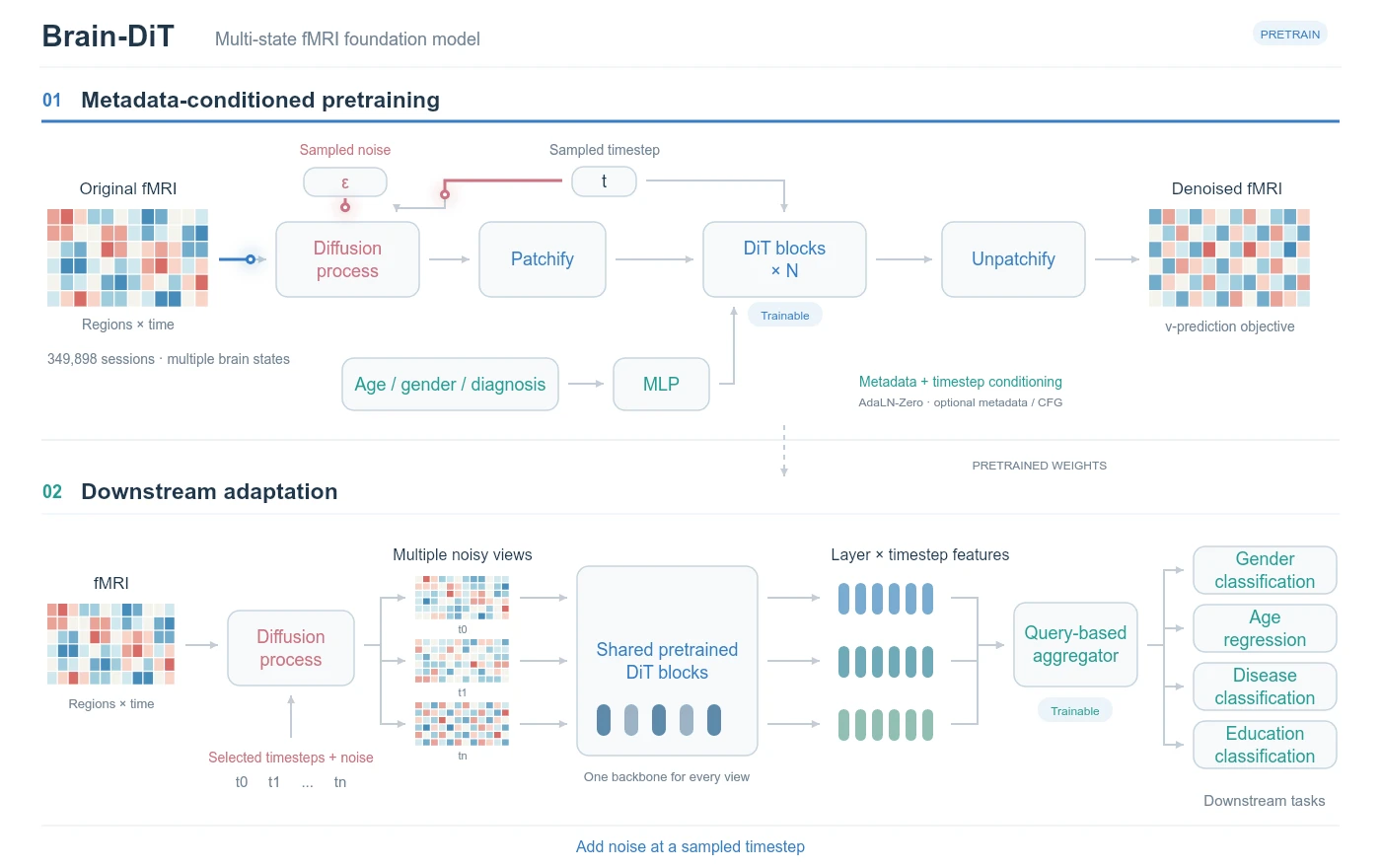
扩散训练逐步向信号加入噪声,再教模型恢复其中的结构。Brain-DiT 将这一过程用于脑区 fMRI 时间序列,并通过元数据描述记录情境。训练后的模型可提供下游预测所需的多层次特征。
动图来自作者 GitHub ↗
方法概览。 上方是元数据条件扩散预训练,下方从多个网络层和噪声时间步提取特征,再通过基于 query 的聚合器完成分类或回归。 原论文 ↗
让不同脑状态共同参与训练
脑区时间序列覆盖静息、任务、自然刺激、疾病与睡眠状态。作者仓库区分完整整理数据与预训练划分,并留出 3 个数据集用于外部评估。
学习有条件的扩散去噪
Diffusion Transformer 在不同噪声水平下学习去噪,并融合元数据条件,同时接触细粒度信号结构与更大尺度的模式。
为特定任务组合特征
下游适配从多个扩散时间步和网络层提取特征,再由基于 query 的聚合器完成分类或回归,让任务自行选择有用的表征尺度。
| 数据划分 | 数据集 | 样本 |
|---|---|---|
| 完整整理数据 | 24 | 349,898 |
| 预训练 | 21 | 317,864 |
| 分布外评估 | 3 | 不参与预训练 |
这里的样本是训练或评估单元,不是去重后的被试人数。
什么样的表征有用,取决于研究问题
实验既考察扩散是否适合作为预训练目标,也考察下游任务应该使用扩散模型中的哪些表征。
扩散目标与元数据都有贡献
在 7 项任务中,扩散预训练优于所比较的重建与对齐目标。消融实验进一步表明,加入元数据条件还能改善下游表现。
ADNI 分类与年龄预测偏好的尺度不同
ADNI 分类更受益于全局语义表征,而年龄和性别预测相对更依赖细粒度结构。因此,不同时间步和网络层的特征具有互补性,这也是任务专属聚合器的出发点。
特征提取方式也是模型的一部分
Brain-DiT 将表征选择显式化:同一个预训练骨干可以提供对信号的多种观察方式,下游任务再学习如何组合。当目标任务与预训练中占主导的状态或人群不同时,这种设计尤其值得考察。
探索项目
可通过代码仓库和关联权重研究多状态 ROI 表征或任务专属的特征聚合。使用时应与公开流程保持相同的输入图谱、预处理和条件字段。
A Universal Multi-state fMRI Foundation Model with Metadata-Conditioned Pretraining
本文由 fMRI Atlas 根据上述原始研究整理。
阅读原文摘要(英文)
Current fMRI foundation models primarily rely on a limited range of brain states and mismatched pretraining tasks, restricting their ability to learn generalized representations across diverse brain states. We present Brain-DiT, a universal multi-state fMRI foundation model pretrained on 349,898 sessions from 24 datasets spanning resting, task, naturalistic, disease, and sleep states. Unlike prior fMRI foundation models that rely on masked reconstruction in the raw-signal space or a latent space, Brain-DiT adopts metadata-conditioned diffusion pretraining with a Diffusion Transformer (DiT), enabling the model to learn multi-scale representations that capture both fine-grained functional structure and global semantics. Across extensive evaluations and ablations on 7 downstream tasks, we find consistent evidence that diffusion-based generative pretraining is a stronger proxy than reconstruction or alignment, with metadata-conditioned pretraining further improving downstream performance by disentangling intrinsic neural dynamics from population-level variability. We also observe that downstream tasks exhibit distinct preferences for representational scale: ADNI classification benefits more from global semantic representations, whereas age/sex prediction comparatively relies more on fine-grained local structure. Code and parameters of Brain-DiT are available at the code repository.
Dataset accounting note: The supplied abstract describes 349,898 sessions. The current author repository distinguishes 349,898 curated samples across 24 datasets from 317,864 pretraining samples across 21 in-distribution datasets; three out-of-distribution datasets are held out. These are not participant counts. The comparison above follows the repository’s explicit split.
BibTeX
@inproceedings{xia2026braindit,
  title={Brain-DiT: A Universal Multi-state fMRI Foundation Model with Metadata-Conditioned Pretraining},
  author={Xia, Junfeng and Ye, Wenhao and Pan, Xuanye and Shen, Xinke and Wang, Mo and Liu, Quanying},
  year={2026},
  booktitle={Medical Image Computing and Computer Assisted Intervention -- MICCAI 2026},
  publisher={Springer Nature Switzerland},
  volume={16894},
  url={https://papers.miccai.org/miccai-2026/0120-Paper1362.html}
}